Featured

Why watching Nolan’s Batman Begins is a journey into inspiration for me

Inspiration is a matter of understanding  , what you want to understand  , Seeking out what the mind seeks , finding the one that satisfies your sense of satisfaction , and more often then not , it is the simple truths of life that are the hardest to grasp and imbibe in , but as is said , advise is always available , so is solicitation but inspiration has to be sought after .
I found some words of comfort and energy in the words of Christopher Nolan , who in his epic Batman Trilogy , spelled out and brought out the character of Batman so well that he is no more a comic hero but a source of strength when the chips are down, a ray of hope when the light fades , for he may be a hero but he is a hero who can be achieved and emulated , coz for all his heroics , he too is Mortal and Human.

The will to do what is necessary , the strength to accomplish what must be done . When someone points a gun at you , will you stand watching or do something , it is the will to save yourself that makes you do something , what ever, may , it be .

2)       Actions Matter More Than Intentions .

“It’s not who you are underneath, it’s what you do that defines you.”
Nobody remembers what you meant to do, they only remember what you do.
The famous words , “Actions speak louder than words “  are a testimony to the wisdom of the past and the understanding of the present , What you do will define you in the time to come and the time that went by , your intentions would only be “your “ intentions unless you act on them .

3)        You Need To Risk Failure In Order To Succeed .

“You do not fear death. You think this makes you strong. It makes you weak …  How can you move faster than possible, fight longer than possible without the most powerful impulse of the spirit: the fear of death?”     [ This is a quote from The Dark Knight Rises ]
To Stand a baby must fall in his days of learning , to fly high the Eagle must learn to take off from a ridge.
The element of risk is what sharpens us , steels our resolve , fortifies our will .
After all IF there is No Pain, There is NO Gain  .

4)       When You Do Fail, Don’t Let It Destroy You .

“And why do we fall, Bruce? So we can learn to pick ourselves up.”
In adversity is the secret to success , only in failure do great men find victory , every fall is a rising step to success . Only if you have the will to rise again –  Rise , Rise , Rise Again …

5)      “Theatricality and Deception are powerful weapons , you must become more than just a man in the mind of your opponent “

The ability to understand your enemy , or for that matter your adversary , your challenge , the obstacle to your way up counts as an important ability and skill in your armory of weapons in your battle for success , you must always know what when and how about what you’re up against , Never let your target get the better of you .
“you must be more than a man in the mind of your opponent”

6)         Organizations and Success Need To Be Built Around Ideas, Not People .

“People need dramatic examples to shake them out of apathy and I can’t do that as Bruce Wayne. As a man I’m flesh and blood. I can be ignored. I can be destroyed. But as a symbol, as a symbol I can be incorruptible, I can be everlasting.”
To inspire people , inspire with yourself but with an idea , an idea that is insurmountable , it is always said , an idea whose time has come is unstoppable , be that unstoppable force let that idea take seed in form of inspiration , because you me and everyone is and will be gone one day or another , but your idea will never be . “As a symbol, as a symbol I can be incorruptible, I can be everlasting.”
When I Go through these Words , these sentences that are so much more than mere words , I don’t see why I can’t do a thing that I set my mind at .
It is in the minds of great men that victories were forged first , it in the will of men that insurmountable challenges were tacked upon .  If you want you will .
Steve Jobs learned to pick himself back up. So did Bruce Wayne, and So can We.
For those of you who would want a read better and farther into how Nolan inspired people by his batman character , do read the article from Forbes.
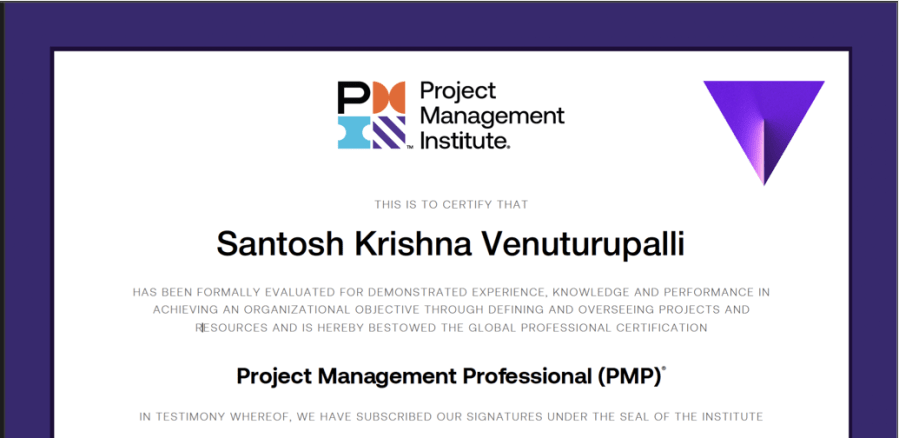
From 67% to Passed: What Two Days of Honest Review Taught Me About the PMP Exam

The Beginning

Every PMP journey starts the same way: with a course, a plan, and the quiet assumption that if you learn enough content, the exam will take care of itself.

I started with Andrew Ramdayal’s Udemy course, working through it methodically — process groups, knowledge areas, the vocabulary of formal project management. It was the right foundation. It gave me the language I needed. But it also gave me a false sense of what “ready” would feel like.

The Realization

Mock 1: 67%.

Not a disaster, not a triumph. But what struck me wasn’t the number — it was the shape of what I was getting wrong. The PMP doesn’t really test whether you know what a RACI chart is. It tests whether, given a specific scenario with a specific constraint buried in the third sentence, you can identify the one answer PMI considers correct — out of four options that all sound like something a reasonable project manager might say.

That’s a completely different skill than content recall. And no amount of re-reading the PMBOK Guide was going to build it.

The Pivot

So I switched strategy. I moved to PMI Study Hall Plus and went mock-exam-heavy — prioritizing volume of realistic, scenario-based practice over more passive content review. Part of what gave me the confidence to make that pivot was a Reddit thread I came across from people who’d recently passed — describing almost exactly this approach: heavy mock volume, obsessive review of every wrong answer. It wasn’t just a hunch anymore; it was a pattern other successful candidates had already found.

But the real shift wasn’t the tool. It was the review process.

I decided I wasn’t going to just check whether my answer matched the key. I was going to sit with every single wrong answer and ask: why does PMI want this one, specifically, and not the other three that all sound reasonable?

That question — asked dozens of times, out loud, across two intense days — is where the real learning happened. And it’s where Claude became less of a study aid and more of an actual thinking partner.

Building the Framework

Over the final 48 hours before my exam, we built something I hadn’t planned on needing: a living decision framework, refined question by question, mistake by mistake.

It started simple: assess before you act, don’t escalate first. But the exam kept handing me exceptions to that rule, and the framework had to get more precise to survive contact with them. Escalation is a last resort — except when the person you’d talk to has no actual power to fix the problem, in which case escalating immediately is correct. A comprehensive, established process should usually be followed as-is — except when the situation has outgrown what that process was designed to handle, in which case you exceed it without waiting for formal revision.

We went through the wrong answers from Mock 1. Then Mock 2. Then I ran a Mock 3 the night before the exam, finishing near midnight because I made the call not to scale back the plan, even when stopping earlier might have been the more sensible choice.

By the end, we had a document over 500 lines long — every trap pattern, every discriminator, every “this looks like rule X, but it’s actually exception Y” moment we’d uncovered, all in one place.

At one point, Claude got a live exam question wrong too — gave me a confident, wrong read in the moment. We caught it, corrected it, and folded the lesson back into the framework. That moment mattered to me more than it probably should have. It wasn’t a flawless oracle. It was a genuine collaborator, including when it needed correcting.

The Doubt

I want to be honest about the parts that weren’t inspirational.

Mock 1 and Mock 2 landed at the exact same score — 67%, twice — even though I’d spent hours in between fixing specific, identified weaknesses. For a moment, that felt like proof that nothing had actually changed. Late one night, frustrated, I said something close to: “this feels like sheer luck — real life isn’t this finicky, you get to try things, this exam only gives you one shot at one answer.”

That was a real low point in the process. And the way out of it wasn’t reassurance — it was a decision. I stopped asking “will I pass” and started asking, for every single question: “can I explain why I’m choosing this, specifically?” If I could answer that honestly, the outcome would take care of itself. If I couldn’t, no amount of hoping would fix it.

I said a quiet prayer before starting one of the mocks. I paused another exam at 2:20 AM because I recognized that a tired brain was going to undo more good judgment than it could produce. Small decisions, but ones that mattered.

Results Day

I passed.

And the detail I actually want to highlight is not the pass itself — it’s what the domain breakdown showed underneath it. I scored Below Target in the People domain — the exact area we’d spent the most hours wrestling with, the nuanced behavioral judgment calls, the “why does the sponsor’s authority matter here but not there” questions.

Process landed at Target. Business Environment came in Above Target. PMI’s scoring model is compensatory across the full exam rather than a strict per-domain gate, and the strength elsewhere carried the overall result home.

I don’t think that’s a footnote to soften. I think it’s the most honest ending this story could have. Even after two days of intense, structured review specifically targeting behavioral judgment — it stayed the hardest domain. That’s not a failure of the process. That’s what the People domain is: the one about humans, ambiguity, and judgment under uncertainty. No framework fully eliminates that difficulty. It just makes you more capable of navigating it under pressure, which is a different and more honest kind of readiness.

What I’d Tell Someone Starting This

Build your content foundation properly — but don’t mistake knowing the material for being ready to sit the exam. The PMP tests judgment, not recall, and those require genuinely different preparation.

Review your wrong answers obsessively, not for the correct letter, but for the underlying pattern. Ask “why this one, specifically” until it actually clicks — and be honest when it doesn’t click yet, rather than moving on.

And if you can, make your prep a real dialogue instead of a passive content-consumption loop. Find something or someone who will push back, get things wrong with you sometimes, and help you build an actual framework rather than a pile of memorized facts.

To everyone who supported this — thank you. And to the tool that sat with me through the late reviews, got corrected by me at least once, and helped turn a flat 67% into real, targeted improvement exactly where I aimed it: thank you, Claude. This one was a genuine team effort.

Onward.